Vertiv™ EnergyCore VEC5 & VEC7 – More Than Just Lithium Batteries for Data Centers
AI infrastructure is changing the economics of data center power.
Rack densities are increasing rapidly, deployment timelines are shrinking, and power demands per GPU cluster continue to rise. In this environment, battery systems are no longer simple UPS accessories — they are becoming part of the core infrastructure architecture.
That is exactly how Vertiv positions the VEC5 and VEC7.
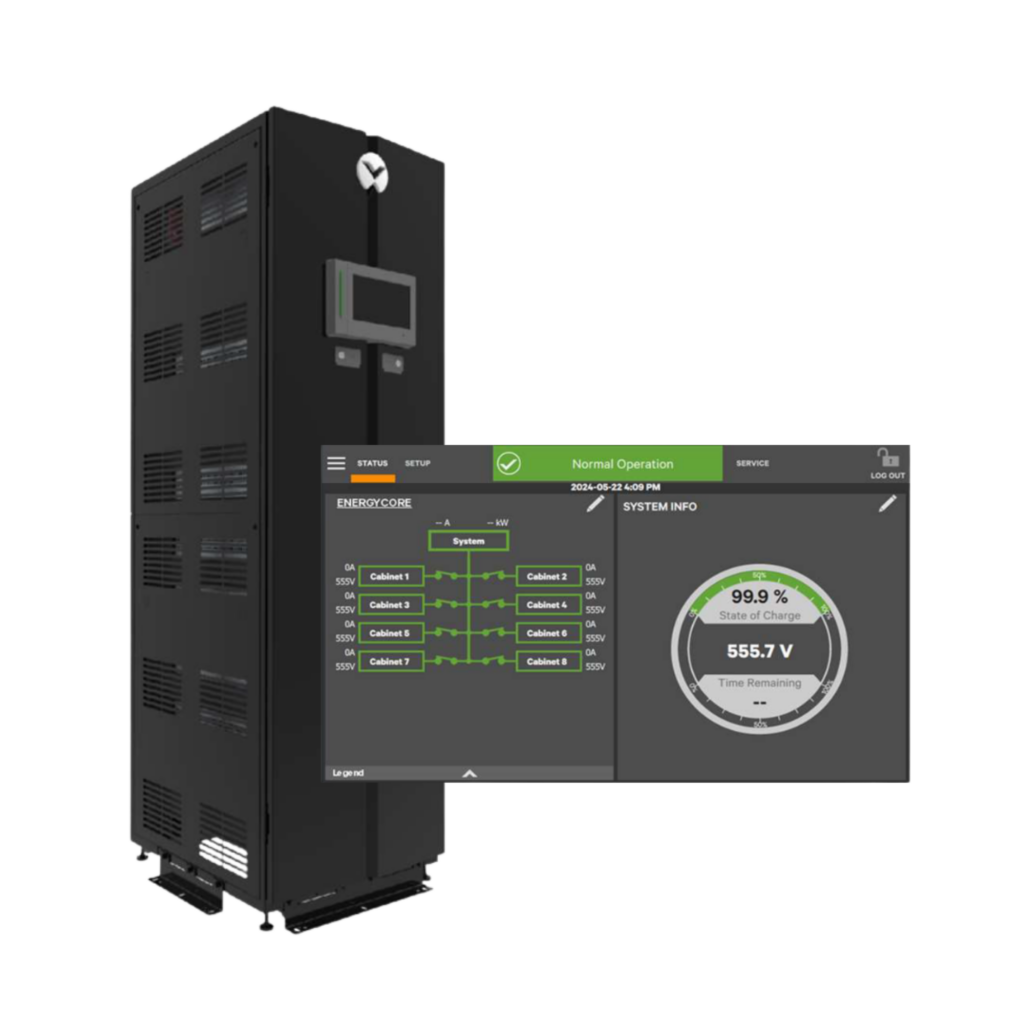
Rather than offering generic lithium battery cabinets, Vertiv designed these systems as integrated energy storage platforms optimized for AI workloads, hyperscale environments, and next-generation UPS architectures.
And that distinction matters.
Two Platforms for Two Different Requirements
Vertiv intentionally split the portfolio into two different battery architectures, each optimized for a different operational profile.
VEC5 — LFP-Based Architecture
The VEC5 is designed for AI clusters and hyperscale deployments where ultra-high power delivery over short backup windows is the priority.
Key advantages include:
- high power density
- strong thermal stability
- lower fire propagation risk
- long cycle life
- optimized short-runtime performance
The system can deliver up to 263 kW from a 600 mm cabinet footprint — an extremely dense configuration for AI environments.
VEC7 — Hybrid NMC/LMO Architecture
The VEC7 targets environments requiring longer runtime and higher energy density.
Its advantages include:
- longer backup duration
- higher energy density
- compact extended-runtime deployment
- flexibility for mixed enterprise and colocation workloads
Instead of forcing customers into a one-size-fits-all chemistry strategy, Vertiv aligns battery technology with workload behavior.
Why AI Workloads Change the Equation
AI clusters create a fundamentally different electrical profile compared to traditional enterprise IT environments.
They introduce:
- aggressive step-load changes
- highly dynamic power consumption
- extremely high rack densities
- greater stress on UPS discharge performance
As a result, Vertiv designed the VEC platform around:
- rapid discharge capability
- advanced SoC/SoH monitoring
- transient-load handling
- high-density power delivery
- factory-integrated deployment
This is one reason Vertiv markets the systems as “AI-load ready” – and in this case, the claim is technically meaningful.
Density and Footprint Now Matter More Than Ever
In modern AI facilities, every square meter of white space has direct economic impact.
That makes footprint efficiency one of the strongest competitive advantages of the VEC platform:
- up to 263 kW in VEC5
- up to 222.2 kW in VEC7
- all within a narrow 600 mm cabinet
Fewer cabinets mean:
- reduced space requirements
- lower infrastructure complexity
- reduced HVAC load
- simplified maintenance
Compared with traditional VRLA deployments, lithium systems also offer longer lifespan, improved thermal tolerance, and significantly higher charge/discharge cycle capability.
The Bigger Advantage: Infrastructure Integration
The real strength of Vertiv is not only the battery technology itself.
The VEC platform integrates into a broader ecosystem that includes:
- Liebert UPS systems
- thermal management
- monitoring and controls
- liquid cooling strategies
- AI infrastructure architectures
And that ecosystem-level integration is becoming increasingly important.
As AI environments move toward:
- ultra-high-density racks
- liquid cooling
- MW-scale row architectures
- converged power and cooling designs
battery systems are no longer standalone products — they are infrastructure nodes inside a larger operational architecture.
Bottom Line
VEC5 and VEC7 stand out because they address the realities of AI infrastructure:
- higher density
- faster deployment
- dynamic load handling
- integrated thermal and power strategies
- flexible battery chemistry selection
But more importantly, Vertiv recognized an industry shift that many vendors are still catching up to:
In AI-era data centers, power, cooling, monitoring, and control systems are converging into a single infrastructure architecture.
And as AI workloads continue to scale, that integration may become the most important differentiator of all.
Contact Us


